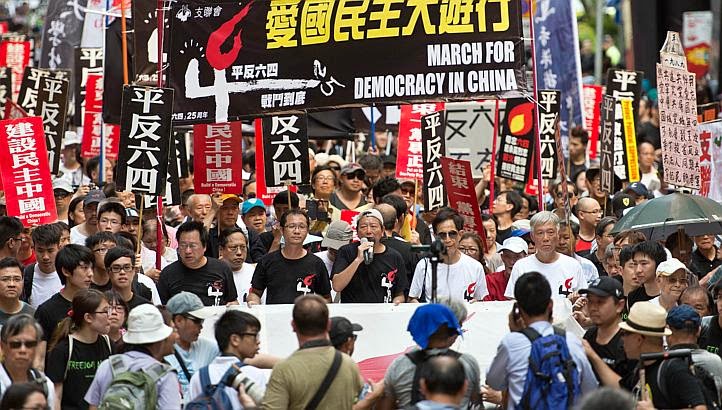
It is an admirable cause to want to protest in fight for
being allowed to choose your own representative dictator without outside
interference.
It is exactly what Hong
Kong protesters have been gathering in streets for.
They want freedom to elect their Chief
Executive, without Beijing's prior approval of the candidates.
Regardless of how things will play out in the end, who will
do what face saving move in order to bring an end to the current protests in
Hong Kong, it is important to take a candid look at who all the major involved
parties are and what is really at stake for each of them, for they and their
interests can reveal what the future may bring to the
world’s freest economy.
Hong Kong people as the main stakeholders are divided on whether
to protest the issue of the universal suffrage.
While most Hong Kong people desire universal suffrage, not everyone is
willing to go to conflict with the motherland over it.
Majority of those who have been protesting
are students.
Born in the years well
after the 1989 Tiananmen Square Massacre, they have never experienced turmoil
in their life.
In comparison with the
past, they were born and have lived in a prosperity that was once unimaginable,
especially the young people that were born and raised Hong Kong.
Most people of older generations, having
experienced many great economic hardships and political upheavals in the past,
desire stability and don't want any confrontation with the central government
in Beijing.
Still, regardless of their
differences on this issue, most Hong Kong people resent the Communist Party,
and don't want any interference in the territory's affairs by Beijing.
Therefore it is not a surprise that so many
people of older generations came out in support of the young protesters, when
fears developed that the Hong Kong government under Beijing's instructions
might use force to crush the protests.
Shaped by the 155 year long history of British rule, Hong Kong people's
patriotism of today
does
not include communism, something which is undeniably well manifested
in these latest 2014 September – October protests.

However, the desire to be free from Beijing's influence is
not all that many Hong Kong people want.
For some, it is merely a step towards much greater ends. The “Umbrella Revolution”
also includes groups that openly call for a full democracy in Hong Kong.
Rise of welfare populism in recent years has
put pressure on Hong Kong government to enact laws and collect taxes to pay for
expanding social services.
Frustrated by
difficulties in passing redistributive legislation due to government's relative
illegitimacy under Beijing's command, the aim of these collectivist groups is
to completely democratize the Hong Kong's government and therefore give it a
full democratic legitimacy to exercise great many powers on behalf of the
people of Hong Kong.
Others are
frustrated by huge inequalities blamed on the elite's capture and control of
the Hong Kong government in key industries such as property development.
Some have thus reasoned that democracy would
bring down property prices, using it as another good reason for them to
protest.
Hong Kong government, much of which is readily controlled by
Beijing, is clearly split between serving the Hong Kong people and appealing to
the greater powers in Beijing. Those
serving the interests of the Communist party are the Chief Executive along with
all the judges and other public officials that he is entitled to appoint, and
about two-thirds of the Legislative Council (LEGCO). Opposing them are the minority civil servants
from the Pan-Democracy camp, which favor checks and balances in government and
universal and equal suffrage.

Hong Kong's powerful corporate special interests are another
stakeholders in the game, who had seamlessly changed their loyalties from
British to Beijing upon returning of Hong Kong to China in 1997.
Here we mean big corporations, which, as a
result of their being deeply in bed with Hong Kong government throughout many
decades, have established effective monopolies and cartels over some of the
essential industries, and that is the actual cause of so many grievances of the
people of Hong Kong.
According to the
Crony
Capitalism Index of the World, despite its small and efficient
government, Hong Kong is ranked as the #1 on the list.


The next stakeholder in line is the Central Government of the People's
Republic of China. First of all, it is important to notice that China needs Hong Kong as it is now, because it depends on it as an important international financial center.
Therefore, it would not be in China's interest to fully integrate Hong Kong into the motherland even today, as it was not in its interest back in Mao's days when it relied on Hong Kong, not just for financial assistance but more importantly, to trade with the rest of the world.
A good example of this trade aspect are the China's Renminbi (RMB) denominated
Dim Sum bonds issued by Hong Kong banks, which saved the day for the RMB currency after Shanghai's
Panda bonds didn't find many foreign buyers.
The West does not trust Shanghai, but it trusts Hong Kong's financial system, which with its Dim Sum Bonds helped turn RMB into a respectable international currency, slowly intent on
rivaling the US dollar's world reserve status.
Even though Hong Kong is
today of much lesser economic importance to the Central Government than it was
during Mao's reign or even at the time of its handover in 1997, the
significance of its political obedience as an inseparable part of China remains
great.
Endless and sometimes laughable
mantra of a harmonious and prosperous society is espoused by Beijing officials
whenever they talk about Hong Kong.
Said
Premier Wen Jiabao in one of his visits to Hong Kong: “Motherland is good, Hong
Kong is good.
Hong Kong is good,
motherland is good.”
It is paramount for
the Communist Party that all its provinces and territories are in line and
loyal to the one party regime.
All calls
for democracy are swiftly crushed and perpetrators severely punished. Hong
Kong's disobedience is particularly troubling, because the central government
cannot interfere in the territory without receiving a global condemnation, or
even worse, economic sanctions and even resulting in war.
Yet, allowing even just one of its
territories to go the way of democracy will encourage others to follow
suit.
So the Communist party is using
its various tools on disposal in Hong Kong to influence the protests.
Besides the already mentioned Hong Kong
government and big business loyalists, the communist regime from Beijing is
also employing NGOs and Triads gangs to disrupt and quell the protests.
Similar tactics with NGOs have been used in
China's efforts at disrupting and suppressing Falun Gong practitioners in Hong
Kong.
But the Communist Party has much more to lose than just a
respectable global financial hub, if it lets one of its provinces to implement
democracy unchallenged.
To them,
democracy is a disease that would eventually spell the end of the one party rule,
and the dream of "Zhōnghuá Rénmín Gònghéguó wànsuì" (
中华人民共和国万岁; literally: "[may the] People's
Republic of China [last for] ten thousand years") would surely soon come
to an end.
On the side note, we all know
what happened to a similar empire long live prediction, that of a thousand year
Reich made by the Nazis.
So all China seems to be doing in regards to the latest Hong
Kong protests is trying to bring an end to the unrest in hopes of preserving
the status quo, so it can resume its subtle and covert
strategy
of gaining even more loyal support and control over the territory.
Other than through its long and twisted
tentacles in Hong Kong government and big business, part of its strategy in
ending the current Hong Kong protests also includes financing
anti-protest
groups that have been tearing down booths and clashing with the protesters.

Finally, there are also some major international third
parties involved, without whom the current protests would not even have started
at the present time, let alone be so
well
run and funded.
The chief
among them is the United States government, which recently
admitted
to funding the Occupy Central movement through many of its government financed
NGOs.
For example, the Washington-based non-government
organization by the name of “National Endowment for Democracy” (NED), together
with its many branches, is infamous in stirring up trouble around the world by
financing groups that start color revolutions and overthrow elected
governments.
“Arab Spring” uprising in
the Middle East and “Euromaidan” civil unrest and government coup in Ukraine,
all of which led to wars and unnamed thousands of people killed and displaced,
the action that continues into the present day, are just a few more recent examples
of their accomplishments. NED's work in Hong Kong with various local NGOs has
been
years
in the making, and it bore fruit as their minions were amongst the
most organized and loudest
groups in the protests.

But the question of course is why?
Why would the US government
create
chaos upon chaos around the world?
And of all places, why also in Hong Kong?
It most certainly was not for the purpose of
making the world safe for democracy, as they
would
like everyone to believe.
It is rather
about Washington's imperial hubris, set on
dominating
the world. It is about global economic, financial, and military hegemony,
necessary to keep the US house of cards standing upright.
It is a rigged system whose purpose is
propping up the profits of Wall Street and
military-industrial
complex.

The US financial system is a Ponzi scheme, sustained only by
the ability of the US government to use force and propaganda to extract taxes
from its citizens, borrow from foreigners, and most importantly to inflate
through printing of money out of thin air.
The last one is especially made possible by the dollar's world reserve
currency status which allows for endless money printing and dumping it on the
rest of the world as its chief export.
In order for this rotten system to keep on going, it must remain
unchallenged by any would-be economic, financial, or military rivals in its
quest for maintaining a complete hegemony over the world.
Maintaining this dominance calls for enormous
spending on corporate media
presstitutes
to keep the masses at home and abroad brainwashed into compliance, running
countless covert operations in many countries abroad, and maintaining the
world's largest
military budget which is greater than the budgets of the next top eight
countries combined.

Simply put, Washington does not want a China,
now
the world's largest economy, capable of
launching
its own
reserve
currency nor doing it jointly as part of the five-nation “BRICS” group,
either of which could rival the US dollar and compete with the World Bank and
the IMF.
It does not want a China
competing in the US national interests around the globe.
It does not want a China capable of exerting
military power to protect its own national interests in its sphere of influence
which the US has its eyes on. It therefore prefers a China that is broken up
into smaller and weaker countries, unable to put up any serious challenge to
the US hegemony in any respect.
For that
purpose, the US uses Hong Kong to weaken and destabilize China any way it can.

So yes, from the perspective of the Washington's chessboard,
Hong Kong protesters are nothing else but useful idiots, tools for advancing
the interests of US government and its corporate cronies. On the other hand, US government's acts of
exploiting genuine grievances and protests of Hong Kong people in order to
advance its own agenda of destabilizing and weakening China, by supporting and
providing financial resources to various populist groups in Hong Kong, is in
effect sidetracking the Hong Kong people from real problems by ignoring and
forgetting the facts that make this place so prosperous and by appealing to
populist push for true democracy, which will slowly but surely take this
shining beacon of economic freedom on the path of socialist Europe, Cuba, and
North Korea.
Please stay tuned for my next post on why democracy
does not equal freedom and why it will destroy Hong Kong.